Uniqueness of Limits
Theorem
A function cannot approach two different limits near a.
In other words, if f approaches I near a, and f approaches m near a, then I = m.
Proof
Since f approaches l near a, we know that for any ϵ>0 there is some number
δ1>0 such that, for all x
if0<∣x−a∣<δ1,then∣f(x)−l∣<ϵ.
We also know, since f approaches m near a, that there is some δ2>0 such that,
for all x,
if0<∣x−a∣<δ2,then∣f(x)−m∣<ϵ.
We have had to use two numbers, δ1 and δ2, since there is no guarantee that the δ
which works in one definition will work in the other.
But, in fact, it is now easy to conclude that for any ϵ>0 there is some δ>0 such that, for all x,
if0<∣x−a∣<δ,then∣f(x)−l∣<ϵand∣f(x)−m∣<ϵ
we simply choose
δ=min(δ1,δ2)
To complete the proof we just have to pick a particular ϵ>0 for which the two conditions
∣f(x)−l∣<ϵand∣f(x)−m∣<ϵ
cannot both hold, if l=m.
The proper choice is suggested by Figure 16.
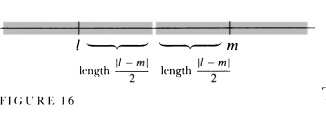
If l=m, so that ∣l−m∣>0, we can choose ∣l−m∣/2 as our ϵ. It follows that there
is a δ>0 such that, for all x,
if0<∣x−a∣<δ,
then∣f(x)−l∣<2∣l−m∣
and∣f(x)−m∣<2∣l−m∣
This implies that for 0<∣x−a∣<δ we have
∣l−m∣=∣l−f(x)+f(x)−m∣(1)≤∣l−f(x)∣+∣f(x)−m∣(2)<2∣l−m∣+2∣l−m∣(3)=∣l−m∣(4)
a contradiction.
Reference Links:
- Step (1) -> (2): Theorem: The Triangle Inequality
- Step (2) -> (3): ∣a−b∣=∣b−a∣ because:∣a−b∣=∣−(b−a)∣=∣b−a∣, 因为任何数与其相反数的绝对值都相等
Reference: Calculus Micheal Spivak. 5. Limits